

Guest Essay: What Steve Herman Saw as Trump Killed VOA
A distinguished White House correspondent for the network shares his thoughts


Once in a while, we will run pieces from outside contributors. This week, we’re proud and thrilled to have Steve Herman discuss the U.S. government’s news media efforts abroad, Trump’s DOGE-run sledgehammer approach to it, and how to move forward.
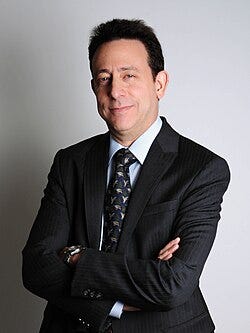
Steve is a former chief national correspondent and White House bureau chief of the Voice of America, where he spent 20+ years, mostly in Asia. Steve is currently the executive director of the Jordan Center for Journalism Advocacy and Innovation at the University of Mississippi’s School of Journalism and New Media, where he is also an assistant professor of practice. Steve is the author of Behind the White House Curtain: A Senior Journalist’s Story of Covering the President ― and Why It Matters (Kent State Univ. Press, 2024).
Have an idea for a piece? Know someone with a story to tell? Pitch us at sreessundaynote@gmail.com!
This year’s destruction of U.S. international broadcasting did not occur in a vacuum. At President Trump’s behest, the Elon Musk-led Department of Government Efficiency (DOGE) cut the likes of VOA, Radio Free Europe/Radio Liberty (RFE/RL), and Radio Free Asia down to shells of their former selves. Endorsed and administered by former Arizona broadcaster-turned-politician Kari Lake, it accompanied the evisceration of USAID and nearly every other cabinet-level government agency.
The current U.S. administration has little interest in multilateral endeavors of any kind, let alone one to project objective information. President Trump routinely expresses his disdain for independent journalism at home and abroad, making U.S. priorities known through the use or threat of military force, economic cudgels, or a combination of the two. In a perverse modification of Theodore Roosevelt’s approach, we carry a big stick, but do not speak.
Shuttering USAID has already led to hundreds of thousands of deaths. Removing the U.S. from global climate change mitigation efforts will only exacerbate the pain both at home and abroad. Abandoning human rights advocacy and scientific advancement—all such initiatives have been cut at the State Department and across the government—only serves to further erode even a semblance of U.S. leadership in the world.
One crucial tool in the U.S.’s moral leadership toolbox, less apparent to most Americans, is its historical commitment to providing reliable news to international audiences in their native languages. Thousands of hours weekly on TV, huge presences on all major social networks, radio and podcasts, deep investigative journalism—it’s all there, and, for more than 80 years, it was a staple of American soft power.
VOA and RFE/RL, with their high editorial standards, are not only major brands outside the United States, they are lifelines. Connecting audiences with accurate and timely information about corruption, civil unrest, epidemics, natural disasters, and everything in-between. They counter misinformation and disinformation in places lacking access to basic facts and devoid context of world events—an act of goodwill provided by American taxpayers for the price of a few fighter jets.
This is the message I have been delivering, since March, in interviews (including on CBS’ 60 Minutes, C-SPAN and MSNBC) and lectures, since VOA was effectively shut down and RFE/RL’s Congressionally-approved funding withheld by the Trump administration.
The rank and file of US international broadcasters and their allies are fighting back in court, arguing executive overreach. As the lawsuits move through the federal judiciary, nearly a half billion viewers, listeners and readers in 63 languages are losing access to objective, fact-checked news and information funded by American taxpayers.
During a recent speech to the World Affairs Council in Springfield, Illinois, an audience member asked in what form VOA and the rest of U.S. international broadcasting could be resurrected for 21st century digital audiences.
The questioner was an 80-year-old Illinois native named Dick Durbin, the senior U.S. Senator from the Prairie State. I explained there should be consolidation and expanded collaboration, not only among Radio Free Asia, RFE/RL and VOA, but with other international broadcasters, especially the BBC and Deutsche Welle.
What follows is the idea that I promised Senator Durbin and the rest of the audience.
The United States external broadcasters could eliminate duplication of more than 20 language services. In regions or languages where one brand is deemed the most effective, language services should operate under only one of the banners.
In sync with the consolidation of U.S. international broadcasting, which must retain the “firewall” protections against partisan or government control of programming, there should be coordination with like-minded outlets elsewhere to reduce overlap.
Such a mechanism exists. The DG8 is the directors general group of international public service media that includes the U.S. entities, the BBC, the Australian Broadcasting Company, CBC/Radio Canada, France Médias Monde, Deutsche Welle, NHK World Japan, and Switzerland’s SRG SSR.
Like the allies during the Second World War, different units could lead in the parts of the world where they have the most strategic interest and relevant assets.
The nerve center would be a World Newsroom with the level of journalistic standards for which BBC and VOA have long been respected. In addition to producing original content, it would collect programming from all consortium participants and re-version it for redistribution for use by the others in different languages. Under this model, a CBC documentary in French about Cajun music in Louisiana could end up on a Deutsche Welle broadcast in Turkish. A VOA news report in Spanish about a contentious election in Peru might be used by NHK’s Mandarin Chinese service.
The reform I envision stems from a revelation I had on a rare reporting trip in 2013 to North Korea, where I met informally over a week with some officers of that reclusive country’s military. They lacked perception of any distinction between VOA and RFA. As the two entities shared the same frequencies in their consecutive nightly broadcasts, the transmissions collectively to the Koreans were from 미국 라디오 (American radio).
For example, wouldn’t it be preferable for Radio France International to focus on Francophone Africa rather than VOA? Deutsche Welle and RFE/RL could be the primary broadcasters to Eastern Europe, divvying up the desired languages, while Radio Free Asia prioritizes Southeast Asia, as well as the repressed Tibetans and Uyghurs. NHK is geographically closest to China and the Korean peninsula—former colonies where Japan desires to improve its relationship and boost trade ties.
This type of enterprise would be a formidable counterweight to the misinformation and propaganda from Beijing, Moscow, Tehran and Pyongyang intended to undermine democracies.
Perhaps Europe and Japan can take the lead and we’ll rejoin them when, eventually, Washington decides to switch back on our beacons to the rest of the world.
***
In June 2024, Steve was my guest on #NYTReadalong, as we discussed his book, “Behind the White House Curtain: A Senior Journalist’s Story of Covering the President — and Why It Matters.”
Have an idea for a piece? Know someone with a story to tell? Are you a student journalist? Pitch us at sreessundaynote@gmail.com!
 | A guest post by
|
"Building Back Better" US Intl Broadcasting would make a good Manhattan project for your advocacy role. Wishing Godspeed.