


🙏 EVERYONE LOVES A DISCOUNT: We are offering a back-to-school sale on paid Substack memberships! Take 20% off by using this link. Thank you for supporting us!
📚 “The greatest literary show on earth” — Tina Brown. Registration is open for JLF USA (featuring six American cities plus Toronto for the Sept. 11-Oct. 4 North American tour of the Jaipur Literature Festival). Please get your tix now to meet 130+ authors, artists, experts and more. We are offering special access to journalists, creators, photographers, etc, in all seven cities, Just fill in this form or write to jlfusa@digimentors.group. Please forward this to your friends in Raleigh/Durham/Chapel Hill, LA, Seattle, Denver/Boulder, Toronto, NYC and Houston.
* * *
LIKE YOU, I HAVE BEEN READING a lot of tributes to Dolly Parton and Gloria Steinem, two women who changed the world for the better. I didn’t want to let the moment pass without sharing some thoughts about them. But I also wanted to comment on the best story I read over the weekend (gift link): Gregory Barber’s profile of 99-year-old Joan Birman, a mathematician who, at 92, teamed up with a high schooler, Vasudha Bharathram, to solve a math puzzle that hadn’t been solved in decades. More on this odd couple in a bit.
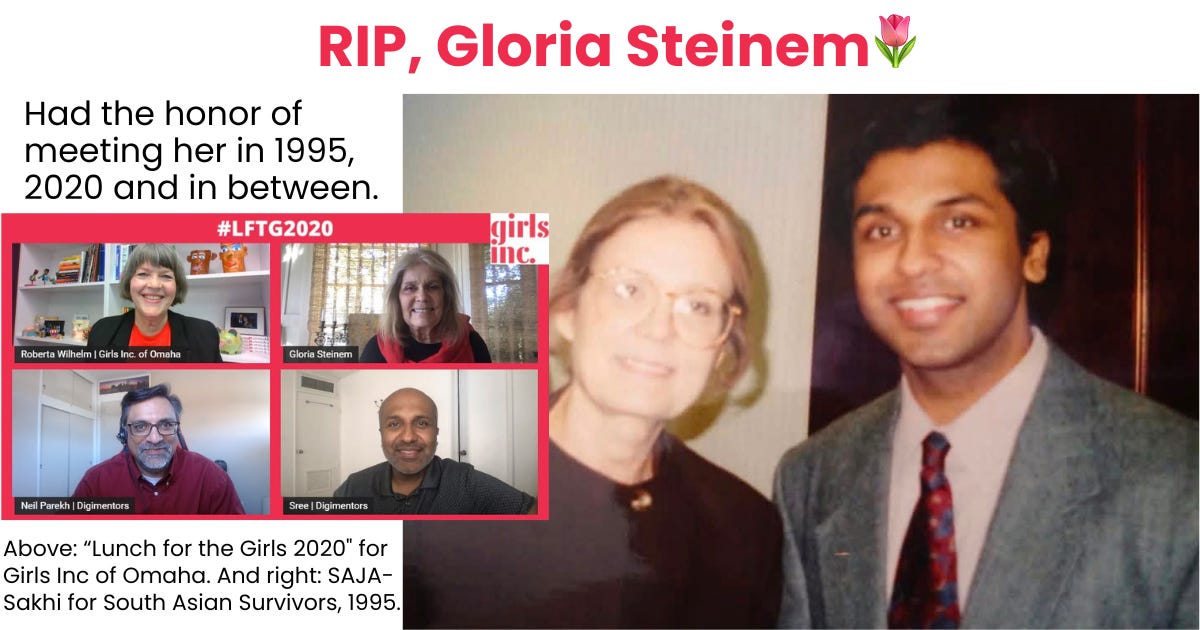
We start with Gloria Steinem, whom I had the honor of meeting multiple times. First in 1995, when she graciously agreed to speak at a joint event of SAJA, the South Asian Journalists Association, and Sakhi for South Asian Survivors (an anti-domestic-violence group). In addition to other talks and seminars she participated in at Columbia University, Neil Parekh and I had the honor of producing a Digimentors virtual event with her for Girls Inc of Omaha; she was the headliner.
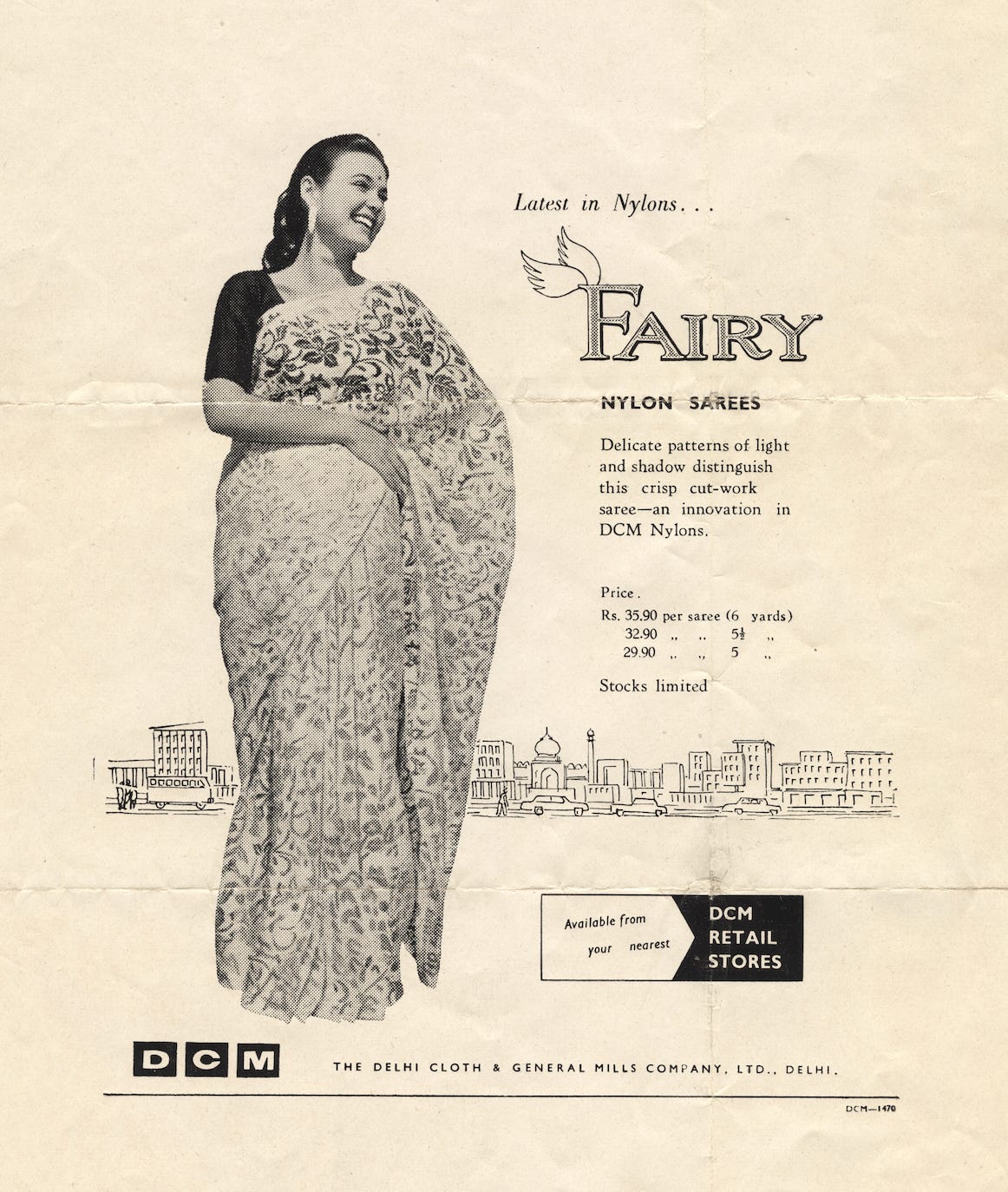
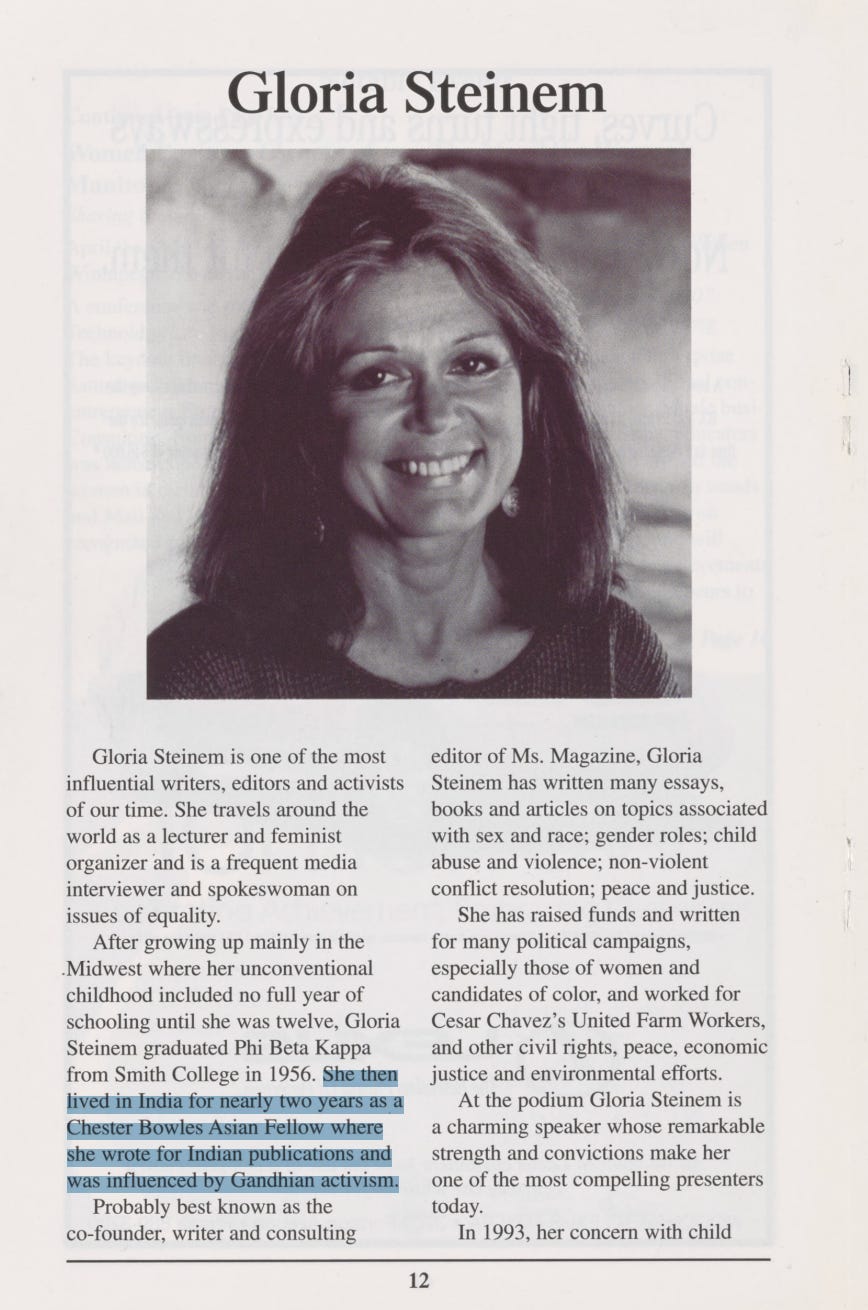
At the SAJA-Sakhi event, she talked eloquently about her deep ties to India in the late 1950s and what she learned there. Well into the 1970s, her official biography contained these lines: She then lived in India for nearly two years as a Chester Bowles Asian Fellow, where she wrote for Indian publications and was influenced by Gandhian activism. Also, see her sari ad in 1958 below (from the Gloria Steinem Papers at Smith College).
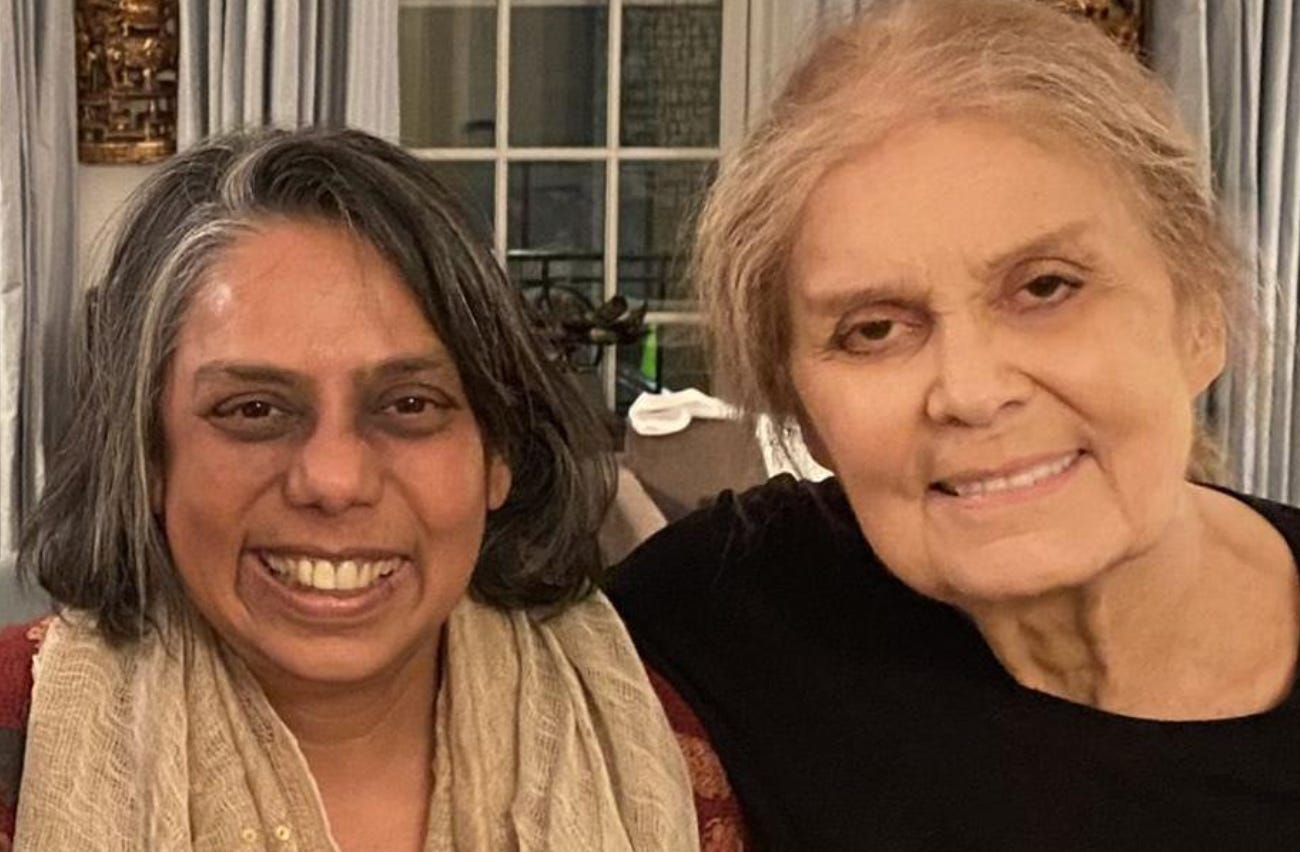
My friend, Ruchira Gupta (above), has written on LinkedIn and in The Hindu about her work with Gloria:
I decided to write tributes in Hindi, English and Bengali to Gloria Steinem because that is what she would have liked. And gave an audio interview to one US radio network.
I hope this gives you a sense of the deeply political person she was. How, like Gandhi, she was open to change, learning from her mistakes, AND transparent about them.
In the Hindu article, I have mentioned our conversations on the CIA and Israel and books she liked.
Her time in India was not confined to two years in the 1950s but over decades. She visited and stayed with me in Delhi, Kolkata and Forbesganj multiple times between 2007 and 2019 to be part of grassroots organizing of Apne Aap Women Worldwide. She visited Ela Bhatt in Ahmedabad and Ritu Menon in Bengaluru.
She never wore a sari on those visits, was just her true authentic self in black pants and black belt, signature round glasses and interesting belts.Her legacy will be in her unflinching commitment to women's rights. She saw patriarchy as the most fundamental of hierarchies, because it is at home that we learn that it is alright for one class of human beings to order and one to obey. Gender digs a trench into our brain into which all other hierarchies fall — like caste and race and we long to replicate power as we learn it, with the head of a family.
Watch a 2014 Asia Society conversation between them about global sex trafficking moderated by Josette Sheeran.
Read an in-depth profile of Gloria’s India connections in “Gloria Steinem: Made in India” by Kaushikee Nayudu and Isha Banerjee in The Juggernaut (gift link).
On to Dolly Parton… In all the coverage, I was struck especially by two things:
Her generosity. In addition to the critical, early, timely million-dollar donation that directly funded the Moderna COVID-19 vaccine, she gave away more than $600 million in her lifetime, from literacy programs (her Imagination Library has donated 300 million free books worldwide) to cancer research (millions to Vanderbilt University) to wildfire and hurricane relief.
Her deep, enduring ties to the Black community and the outpouring of love from Black musicians and others when she passed.
The Dolly Parton Black America embraced, by Keith Murphy in Andscape.
From Whitney Houston and Charley Pride to Queen Latifah and Beyoncé, the country music legend built bridges across genres, generations and communities.
Dolly Parton Made an Undeniable Mark on Black Culture, by Brandon Tensley in Capital B.
The country legend’s reach was vast, making an impact on everyone from Whitney Houston to Lil Nas X.
Dolly Parton and the Black Artists Who Expanded the Meaning of American Music, by Diahanne Rhiney in Black Wall St Media.
What happens when a country music icon’s legacy intersects with the Black artists who helped shape the very sound of the genre?
Zach Peterson, my friend and newsletter collaborator, writes:
I grew up in a household that listened to old country music (it was even old at the time). My dad has a record collection to envy, and most of it is pre-1980 country music. Dolly Parton was a big part of that. Her, Patsy Cline and the Judds were the female artists I grew up with.
As my musical taste changed rather drastically, my appreciation for Dolly and the artists of her time never really waned. I may still love a good mosh pit, but I can still sing along with Dolly and Patsy all the same. Good music is good music. When I left home for adult life, I fell back into Dolly when I saw The White Stripes play Jolene live sometime in the early 2000s. It rekindled my love for her music. On top of her enormous performing and writing talents, she was everything anyone could want in a hero.
With everything you’ve read and seen about Dolly, bet you haven’t seen this. It’s her rendition of “Stairway to Heaven” by Led Zeppelin!
And now, to Joan Birman, who is still with us at 99. A Columbia mathematician who thought her best work was behind her at 92 until she met Vasudha Bharathram, a high schooler who insisted they could solve something important together. It’s the best story I read over the weekend (gift link). NYT’s Gregory Barber writes:
I reached out to Joan Birman with the idea of profiling a 99-year-old mathematician who had just published a major result — not an everyday occurrence!
But Joan was adamant that she wasn't the story. The story, she said, was about an intellectual partnership that began with a teenager's out-of-the-blue message seven years earlier. I've found reporting this story to be a tonic in a math news cycle dominated by A.I.-generated results — a reminder of the human artistry and tradition at the core of mathematics.
The story is worth your time even if, like me, you know nothing about mathematics.
— Sree / Twitter | IG | LinkedIn | FB | YouTube | TikTok | Patreon
Have an idea for anything we’re up to? Let’s collaborate! sree.sreenivasan1@gmail.com
Prefer Patreon? You can chip in $2 or more to support all our online shenanigans: this newsletter, NYT Readalong, the 30-group WhatsApp Community I run (specialized groups on AI, hip hop, baseball, diabetes) and more! Here’s our Patreon link.
Or use take advantage of our 20% off sale right here on Substack.
OUR MOST RECENT POSTS:



Wow, fascinating Joan Birman. Excellent read! Looking forward to what heights the newly minted Princeton mathematician will scale. So cool.