


✍️ Are you a journalist looking for experts and sources? Publishers like National Geographic, the BBC, and countless industry trade pubs, trust Source of Sources to connect them with expertise that they often struggle to find. And if you are an expert looking to be quoted, you can get daily emails consolidating requests from journalists on deadline. This is a project by my friend Peter Shankman, who changed comms by creating Help A Reporter Out back in the day. Sign up for free(!) here. [This is a partner message]
👌🏾 Every word in this newsletter was written by a human being. We use AI for research help, but not text generation. See tips from my 24-day, 5-country AI training tour of Asia. And read my 20+ essays on AI.
🗞️ Every Sunday, from 8:30-9:30 am ET, Neil Parekh and I host the NYT Readalong. Join us live or later on my social feeds or at Digimentors.group/nytreadalong. Now also a podcast on Apple & Spotify. Today, you can download a free pdf of “The Ten-Minute Challenge,” a special section in the Sunday New York Times.
🙏 Thank you to all our new paid subscribers! They and our sponsors help us do more. Here’s how you can support Sree’s Sunday Note, even if you can’t afford to pay.
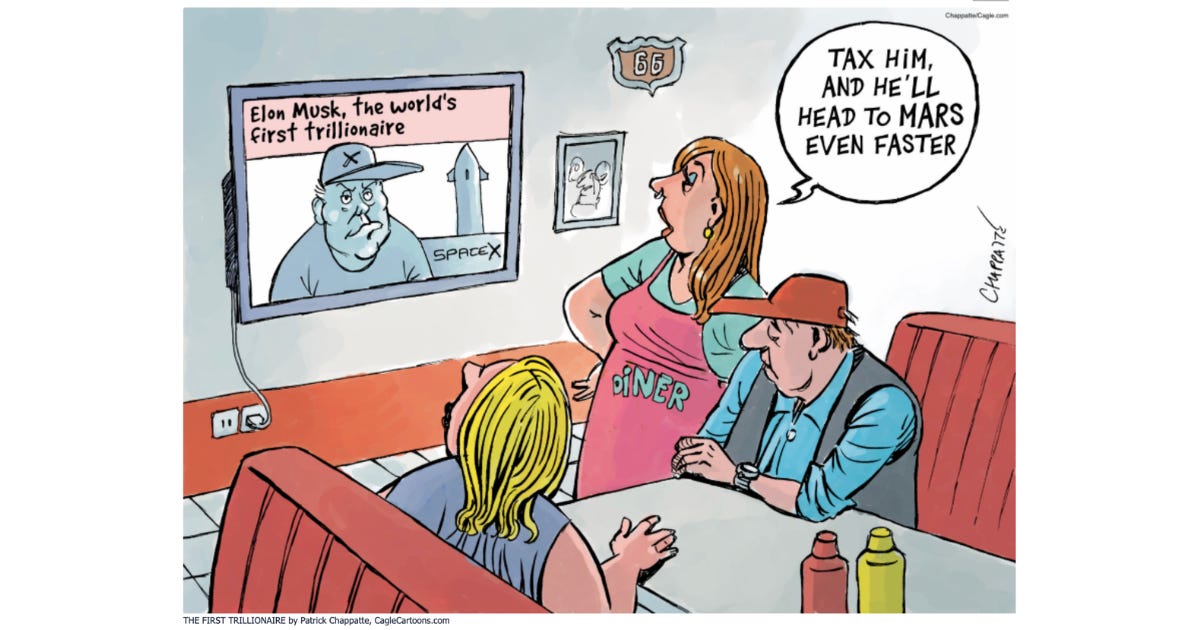
ELON MUSK—ONE MAN—IS WORTH ONE TRILLION DOLLARS. People caveat with “on paper,” but what’s the difference? SpaceX, the brand, is a company that can launch, land, and reuse rockets. SpaceX, the business is Starlink connectivity and AI, which combine to account for 78% of the company’s revenue. Is SpaceX really a $2 trillion company? For now, it is.
Musk is celebrating his trillion-dollar achievement by directly stoking racist pogroms in Belfast, for which X/Twitter will apparently face no consequences. His Grok AI has government contracts. This is an abomination. He is an abomination. He did his best to destroy the government, and now he’s escalating with a net worth that makes him a global power.
SPEAKING OF TRILLIONS OF DOLLARS… AI giants Anthropic and OpenAI will be trillion-dollar companies when they go public sometime in the next few months. This is the scale we’re talking about: somewhere between three and five trillion dollars spread among three companies. Add Nvidia, Microsoft and Apple, and we’re talking about something like $17-20 trillion dollars of value/market cap. Staggering.
My question is simple: How long will public investors tolerate extensive losses in the quest for market capitalization?
It’s tough to say, but the numbers are out of this world.
From Ed Zitron:
Let’s say that Anthropic keeps growing and (as The Information suggests) hits $100 billion in annualized revenue (around $8.3 billion a month). How, exactly, does it afford to make that much money? Because right now it’s (allegedly) about to hit $45 billion in annualized revenue, and needs so much money that it’s absorbing (along with OpenAI) the majority of venture capital raised this year, and very clearly does not have any path to bring its costs down.
The answer is simple: it can’t! There is no mechanism to do so. More compute does not make OpenAI or Anthropic’s services cheaper to offer. There is no magical silicon coming that will make any of this more affordable, and no, Anthropic is not “profitable on inference,” because if it were, that massive revenue growth would have leveled out its margins rather than require it to raise a little less than the combined value of every Major League Baseball team, or more if you add the other $50 billion that Amazon and Google have promised based on secretly-held performance obligations.
The same goes for OpenAI, which “raised” $122 billion (around $45 to $50 billion in real cash, with the rest either paid in installments or on it IPOing or reaching (sigh) AGI) in February and is now already considering raising more.
I saw a tweet once that said something like, “Ed Zitron has successfully predicted 9 of the last zero AI industry collapses,” but I think Zitron’s skepticism about the business side (see: financials) of Big AI tends to be very smart and well-reasoned.
The path to profitability goes through higher prices; that’s just a fact. The day these companies go public is the day private investors stop subsidizing operating costs. On the consumer side, this will matter a lot. The more people use AI, the more expensive it is for companies to offer AI as a service. Again, the math is quite simple.
But, the fact that the numbers are out of this world may be exactly the thing that undoes Zitron’s point. For now, anyway.
I recently hosted a SRoopa Salon at my Manhattan apartment on AI with some true luminaries. We’ve been running these gatherings IRL for three decades. We are now adding virtual versions as well as priority access for paid subscribers.
We ignore the unprecedented momentum of AI giants at our peril. This Rutger Bregman post summarizes it nicely. Anthropic’s $45 billion in annual revenue as of April 2026 is up 44-fold over the last 15 months. ChatGPT reached 100 million daily users in light-years quicker than Instagram or really any other platform. SpaceX just became the largest IPO in the history of IPOs. The infrastructure investment being laid out in pursuit of this is like nothing we’ve seen before.
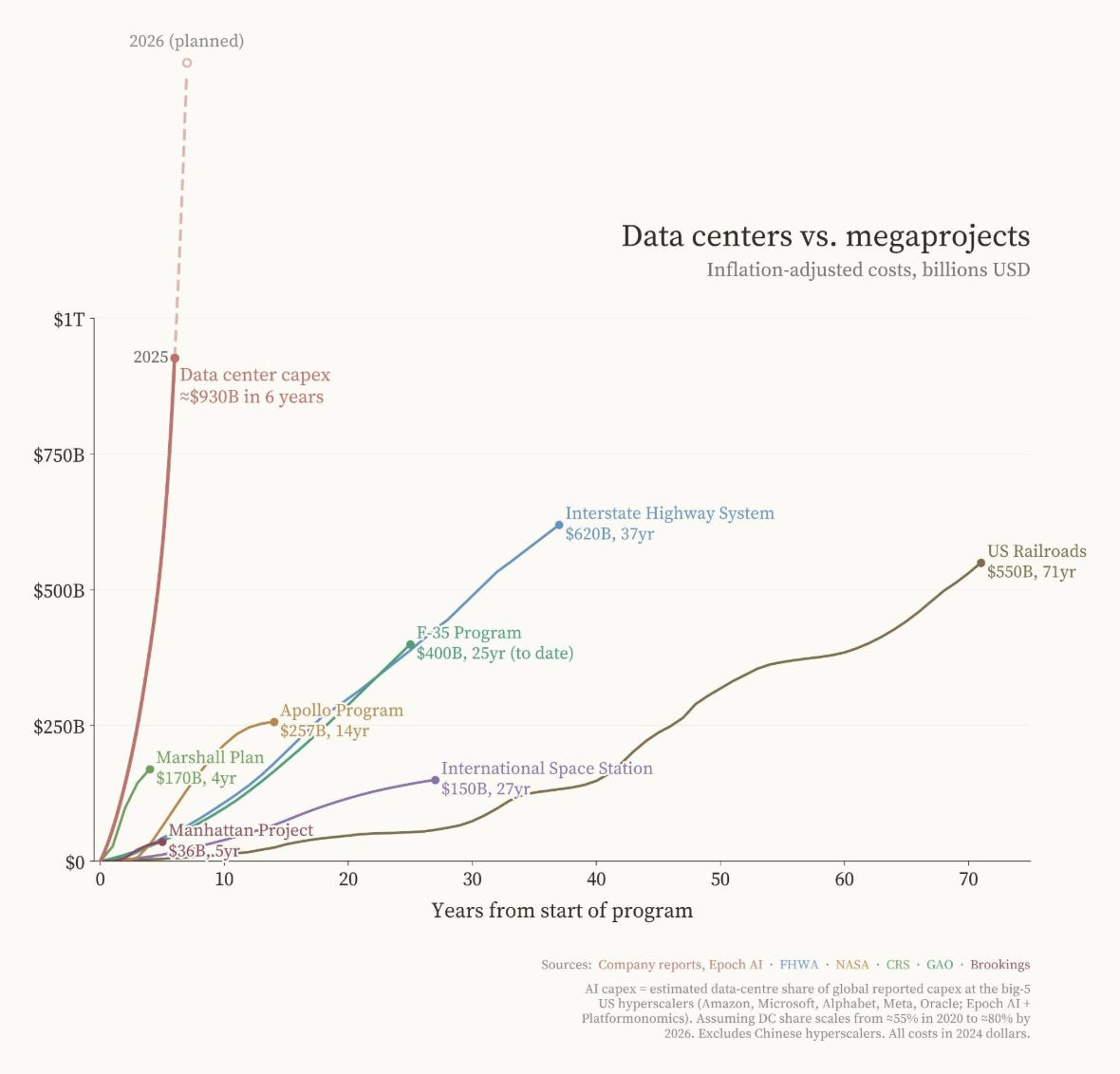
From Bregman:
[I]f this is really such a useless and fraudulent bubble, then why are people paying so much money for it? Why is the demand for AI rising faster than companies are able to build data centers? Why are IT departments, in the words of a Goldman Sachs analyst this April, overrunning their AI budgets “by orders of magnitude”?
I’m sorry to say it, but there’s a lot of highbrow misinformation circulating in left-wing media about AI. Take that viral MIT report. Read it carefully and you see the headline got it backwards. The “95% failure rate” includes the 80% of companies that never piloted any AI in the first place. As the podcaster Rob Wiblin pointed out in a careful breakdown of the study, this is like saying 95% of Tinder users have failing marriages, when most of them have never been on a date. Among the companies that actually deployed AI, about a quarter succeeded within six months. And the study’s own data shows that more than 90% of workers at those companies are using ChatGPT or Claude regularly at work, often multiple times a day.
Bregman is always thoughtful, and I am inclined to agree with him here. Warts and all, AI will persist, right up until it doesn’t. I see little reason to think otherwise. If this is a bubble, it looks like it will be a pretty long-lasting one. Bregman lays out a very clear-eyed way of looking at the industry, and how to at least attempt to check the advancement in an effective way.
This gets back to the original question: How long will the public subsidize the industry? The bill will come due at some point, but the industry may be far enough along on the tech and product front to weather a fallout and consolidation (or, de-consolidation, as the case may be).
Make no mistake, the environmental toll this is taking and will take will be shocking, even by modern humanity’s standards. This is from a new report out of the United Nations University Institute for Water, Environment and Health:
By 2030, the global data centres powering artificial intelligence are projected to consume 945 terawatt-hours of electricity. This is nearly triple the combined annual electricity use of Pakistan, Bangladesh, and Nigeria—countries collectively home to more than 650 million people.
Their associated water footprint will equal the basic annual domestic water needs of all 1.3 billion people in Sub-Saharan Africa, and their land footprint will exceed 14,500 square kilometers, roughly twice the Jakarta metropolitan area, home to more than 32 million people.
That all seems straightforward and quite dire. It does not strike me as inevitable, however; at least not yet. Opposition to data centers is increasing all over the country, and AI, to date, has been remarkably cheap. It’s a regular old venture capital play—invest heavily, sacrifice profit for market share, acquire for scale, go public, raise prices. It’s a tale as old as time.
We the people are also subsidizing these companies, and, as Rebecca Crosby at Popular Information clearly documents, state budgets are starting to feel it. States like Ohio, Texas, and Virginia, have lost tens of billions of dollars in tax revenue from exemptions for data centers over the last few years, and they will lose more in the next five. People are feeling this, and it matters a lot. There will be elections decided on data centers like never before. Veteran journalist Karen Hao has launched a fascinating new project, “The AI Resist List”, and is documenting, learning, and theorizing on the future.
How this ends, I have no idea. With Trump in office, U.S. tech giants are going to take advantage of any and every lever to continue hyperscaling. Some pushback from the public should also serve to catalyze industry to innovate and make all of this more efficient.
AI has already changed my day-to-day life in ways I struggle to even explain. I’m not going to sit here and say I don’t find great use for this technology—I do. I struggle with the environmental toll, but I also know that I am but a drop in a rapidly-expanding bucket—my token usage might by high-ish for the average person who does what I do, but I am not tipping the scales in any measurable way.
I am a user, a skeptic, and a teacher, occasionally all at the same time. I also refuse to be left behind in this race, because I truly believe AI will be a major part of our lives in the foreseeable future.
I maintain (and try to moderate) a Talking AI group chat on WhatsApp, and it’s turned into something more valuable than I could have imagined. There are some great minds in the group, and several deeply technical experts and practitioners—and I have learned so much.
Here’s a sampling of what we’ve been discussing in the group:
[NBC News] “Most U.S. doctors are quietly using this AI tool. Few patients know about it.”
Talkin’ AI group member Jamie Metzl on Pope Leo’s AI Encyclical
[The Yale Review] “How LLMs Set My Fiction Free”
You can sign up here. It’s free.
Thank you all for joining me on this journey. The support is noticed, appreciated, and, one day, I hope to repay it in-kind.
— Sree / Twitter | IG | LinkedIn | FB | YouTube | Spread | TikTok
45% of 2026 is already over. What will you do with the remaining 55%? LMK and I’ll see you made it all the way down here.
One of the Best Things I’ve Ever Read #8
We’re aiming to create the best reading/viewing/listening list possible. It’s quite simple—we are crowdsourcing the writing that has stuck with you, that one thing you read last month, last year, or 20 years ago, that has stuck in your brain. This week, it’s an excellent addition from Jasmeet Singh Gandhi.
Title: “Revenge of The Business Idiot”
By: Ed Zitron (Published on May 26, 2026)
From Jasmeet:
I liked that this piece steps back from the usual AI discussion to ask a more fundamental question: what happens if disruption becomes so fast that markets can no longer value the distant future?
It provides a decent framework for thinking about how AI can reshape not just industries, but also how capital is allocated and how businesses are valued.
Jasmeet Singh Gandhi is a partner at Founder’s Room Capital.
If you have a story to share, please do!
Have an idea for anything we’re up to? Let’s collaborate! sree.sreenivasan1@gmail.com