


🙏 EVERYONE LOVES A DISCOUNT: We are offering a back-to-school sale on paid Substack memberships! Take 20% off by using this link. Thank you for supporting us! Another way to help is to share this with your colleagues, family, and friends.
A paid subscription or sponsorship helps us do more—like talk to David Gelles, NYT climate reporter and bestselling author (see video here); and, somehow, get an hour of time with Dr. Shawna Pandya, the first female commercial Canadian astronaut (video to come). Plus, a livestream this coming Tuesday with Kamini Ramani, Silicon Valley insider (she advised Steve Jobs, among others) and author of Lotus Leadership: A Modern Playbook of Ancient Wisdom (details below or here).
📚 “The greatest literary show on earth” — Tina Brown. Registration is open for JLF USA’s remaining four cities. We are offering special access to journalists, creators, photographers, etc, in all seven cities, Just fill in this form or write to jlfusa@digimentors.group. Please forward this to your friends in Denver/Boulder, Toronto, NYC and Houston.
***
IT’S BEEN A WEIRD MONTH FOR THE AI GIANTS. Founders, CEOs, chief scientists, and, basically, anyone who’s anyone in AI is saying that frontier (ie, cutting-edge) AI model development is moving too fast.
Calls for AI development slowdowns are not new, but they also aren’t usually co-signed by the leaders of the companies that stand to be most affected.
The problem here is that Sam Altman, Dario Amodei, and Elon Musk could just do what Amodei himself says “is surely a good thing,” tomorrow. If Altman thinks OpenAI should pump the brakes before the machines start deciding they don’t need humans, why doesn’t he just pump the brakes? Why doesn’t Musk just halt all infrastructure deals for Grok for 6 months starting on Monday? The short answer is “investors.” The long answer is, “Hundreds of billions of dollars in infrastructure investment and investors wanting their return.”
The timing of these industry PR moves—that’s what they are, PR moves in search of a policy solution and/or protection from their investors—is the brightest flashing lights here. We are approaching that magical moment when breakneck capitalists become socialists without saying it out loud. The investment is private, the profits are private, the government needs to get out of the way, the power is concentrated…right up until it’s time to socialize the risk.
Anthropic’s Amodei spent nearly 4,000 words on the topic of “pacing” cutting-edge AI development.
The current models are an almost endless gold mine of insight into both how to build AI well and what can sometimes go wrong with it if it isn’t built well. I believe that if slowing down bought us even an extra year or two before models reach critical levels of capability, and we used that time to advance alignment, we could greatly reduce the risk that something goes seriously wrong.
A coordinated pacing strategy would give frontier AI developers the time to do this vital work without sacrificing commercial advantage or the United States’ lead in AI. More generally, society must have a say in how this technology is used, and more time for the necessary public deliberations — which pacing the frontier would bring us — is surely a good thing.
That all sounds benevolent enough, if it weren’t for the facts on the ground. Here’s Anthropic’s announcement of a $20-million-dollar “donation” to Public First Action, the organization that controls two Super PACs—Jobs and Democracy PAC, aimed at Democrats, and Defending Our Values PAC, aimed at Republicans. They are spending, and they have very powerful backers. Don’t let these people fool you, Amodei is sending millions to the same Super PAC as Mark Andreessen, Greg Brockman, and their lot of techno-libertarian activists. There are no “good guys” at the top of this industry.
As I wrote back in March of 2025, the Tech Bros are out for political power, and they are trying, right now, to buy it all. By himself, Musk spent $300 million on the 2024 elections in the U.S., and it’s tough to say how much he spent in other countries. What’s worse is that almost all of them are cut from the same intellectual cloth, and they have already installed their man in the second most powerful position in the U.S. government.
From “Is It Too Late to Stop the Tech Bros?”:
The people who possess the wealth, influence, and in some cases the knowledge needed to solve humanity’s core problems—things like poverty, climate change, hunger and disease—are choosing instead to build island doomsday bunkers and profit off the end of the social order until there are no more profits to extract and the state ceases to exist. These are the people deciding the future of Social Security, Medicare, Medicaid, our military, the environment, education, scientific research, and so on down the line.
PARTNER MESSAGE
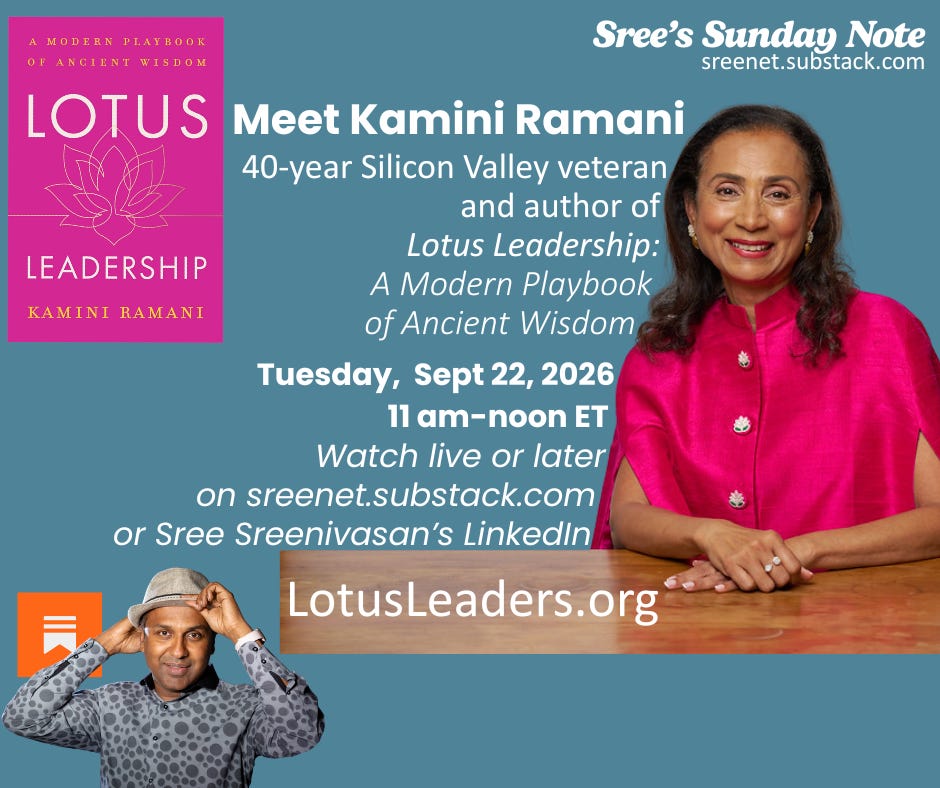
Looking for an antidote for all the tech-bro nonsense hurting the world? Then this book, releasing Tuesday, is for you. In Lotus Leadership: A Modern Playbook of Ancient Wisdom, author Kamini Ramani has written a book that features 33 of the most powerful women in the world: executives, founders, scientists, movement leaders and many others and shows us that women can truly show us the way forward. Kamini, a Silicon Valley insider (she advised Steve Jobs, among others), will do a livestream interview with me on Tuesday right here on Substack. You can join by going to this link on Tuesday, Sept. 22 at 11 am ET. The recording will be shared in my newsletter later.
In a nutshell, what happened over the last many days is a couple thousand people at the heights of the AI industry signed an e-card telling us how scared they are of the thing they built that is following their instructions perfectly and exploiting their programmers’ mistakes.
Juliette Kayyem puts it very plainly:
Reality check: if any other private company said “hey we built this really cool thing and we already know we can’t control it but we continued forward even though we knew it could go rogue and kill everybody,” we would shut it down and prosecute the madmen.
The AI boys use the word “rogue” to deny their own culpability, as if the dangers AI poses are just a mistake. That’s just marketing. What they have built is designed to go rogue. Their language is the vocabulary of deniability, to deny that they had intent. Don’t buy it.
Words matter, and the tech bros still fail to grasp that simple fact. There’s nothing “rogue” about programs doing the things they are programmed to do—it’s what every computer has ever done. If it’s so dangerous, again, just shut it down.
I asked a true expert on AI, Patrick Grady, to share his thoughts on the current round of doomsday predictions as well as his own predictions on how these will shake out. He also runs the Archive of Incorrect AI Predictions and Half Full AI and is Head of European Tech at the Information Technology and Innovation Foundation. From Patrick:
I’ve met researchers in these labs, and I have no doubt that Jacob Coxson and his AGI-pilled colleagues believe AI is an existential threat. Most AI experts say there is no proof of this idea. It overstates what software can do and overlooks the real world’s complexity.
Something in the Californian water gives a subset of AI professionals the courage to advertise their fantasies, like the researcher who claimed in 2022 that Google’s LaMDA was sentient or the journalist who announced in 2023 that Bing’s chatbot had fallen in love with him.
As for the leaders of these companies, it’s a huge mistake to take their claims at face value. Amodei warned in 2019 that GPT-2 was “too dangerous” to release (only to set up Anthropic and race ahead), and Musk called for a pause on AI in 2023 (only to set up xAI). I won’t speculate on their motives, but we should be cautious of early governance proposals that seem to favour incumbents and concentrate power.
Venture capitalist Roger McNamee went so far as to say that the frontier AI companies are trying “to find a way to get the government, in the interest of safety, to ban the competing open source products.” It’s the most classic of startup strategies—use private investment to capture market share, vacuum up capital and talent, and then build a moat if you can.
Since I know little about open-source AI, I turned to my friend Nithya Ruff, who chairs the Linux Foundation board. I asked her to explain what the heck is going on. From Nithya:
Think of it as the difference between being handed a finished dish and being handed the recipe. Most of what gets called open today—Meta’s Llama, DeepSeek’s models—hands you the finished dish: you can download it, use it, build on top of it, and that’s real progress.
But you still can’t see the recipe, what data trained it, how it was trained, whether the claims made about it hold up. True openness means giving away the recipe too: the data, the training method, and the code, the same standard we’ve always held ordinary software to.
That distinction matters more than it sounds like it should: it’s the difference between a country or a company being able to genuinely switch away from one AI provider, versus being permanently dependent on whoever built the model they started with.
There’s no better moat in business than a regulatory one, and that is clearly a goal here if not the goal. The tech moguls are throwing everything they can at this, sometimes at cross-purposes. They are united by profit margins and investment returns, to be sure. But do not downplay the philosophy behind all of this. These men are true believers—they follow the teachings of people like Curtis Yarvin and Eliezer Yudkowsky—and they all talk to the same people. If you’re feeling academic and want the full story, read this seminal paper by Temnit Gebru and Émile P. Torres.
They’ve created the second greatest word-generating machine in history, but it’s all still a distant second to humans. They trained their multi-billion-dollar supercomputers on the full spectrum of human creativity and ingenuity to build a machine to replace it. It’s a level of intellectual nihilism that is almost hard to fathom. Here’s a screenshot of part of the unsealed Summary Judgment motions in New York Times v OpenAI / Microsoft, via Jason Kint on Bluesky. His whole, disheartening thread is here.
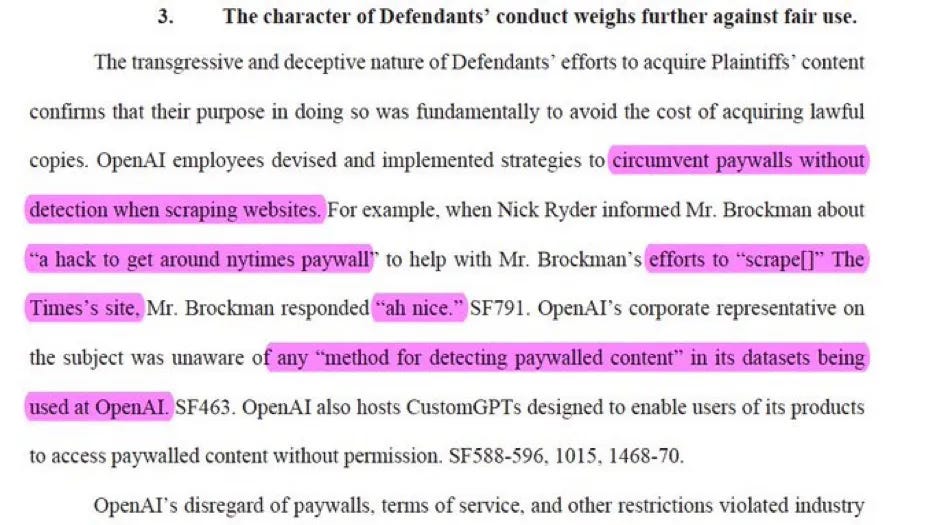
That’s OpenAI President and Republican mega-donor Greg Brockman replying “ah nice” when ChatGPT got around the NYT paywall. Another stunning quote from the document: Microsoft’s Director of Applied Science called AI “an astonishing theft of unprecedented proportions” and “the largest theft of labor in human history.”
It all might be too late anyway. Maybe the cat’s out of the bag with AI, even in this nascent state. AI is powerful right now, and there are future versions of it that are capable of… well… we don’t know what they’re capable of! We know that people are trying to create bio-weapons and any number of horrible things with AI. The U.S. military wanted to use Claude for weapons targeting. Maybe it—whatever it is—is already here.
Assuming the end is not near, we need to interrogate every aspect of this industry. We have people in positions of extraordinary power basically throwing in the towel already, a president wholly uninterested in regulating anything, and unthinkable amounts of money being spent to change your mind on all this.
I encourage you to click through the links I’ve included throughout this newsletter. They link out to credible sources you can trust.
Here’s my friend Jamie Metzl, co-author, with GPT-5(!), of The AI Ten Commandments to take us home:

— Sree / Twitter | IG | LinkedIn | FB | YouTube | Spread | TikTok
Have an idea for anything we’re up to? Let’s collaborate! sree.sreenivasan1@gmail.com
🙌 Prefer Patreon? We have just revived our account there. You can chip in as little as $2 or more to support all our online shenanigans: this newsletter, the Sunday NYT Readalong, the 30-group WhatsApp Community I run (specialized groups on AI, hip hop, baseball, the law) and more! Here’s our link.
Or just take advantage of our 20% off sale right here on Substack.
READ MY 20+ ESSAYS ON AI:
https://sreenet.substack.com/t/ai
You’re invited to join my LOW-VOLUME, HIGH-UTILITY WhatsApp discussion group about AI. Multiple people have described it as the best way to keep up with the changing AI landscape. It’s a global gathering of experts, non-experts, journalists and more. Lurkers welcome, leave anytime: http://tinyurl.com/sreewaai2
Terrific piece, Sree.