

The AI Giants Are Consuming Everything
An old-school strategy for these cutting-edge companies.

🙏 Thank you to all our new paid Substack subscribers! They and our sponsors help us do more. Prefer Patreon? You can chip in $2 or as much as you like to support all our online shenanigans: this newsletter, the Sunday NYT Readalong, the 30-group WhatsApp Community I run (specialized groups on AI, hip hop, baseball) and more! Here’s our Patreon link.
📚 “The greatest literary show on earth” — Tina Brown. Are you a journalist, creator, blogger, writer, etc? If so, JLF USA (six American cities + Toronto representing the North American editions of the Jaipur Literature Festival in Sept & Oct) wants to connect with you and give you special access to the amazing speakers, authors, etc, appearing at the literature festivals. Just fill in this form or write to jlfusa@digimentors.group.
* * *
EVEN NOBEL LAUREATES can get stuff wrong occasionally. In 2016, Geoffrey Hinton, one of the godfathers of AI, said, “People should stop training radiologists now. It’s just completely obvious that within five years deep learning is going to do better than radiologists.” Here we are 10 years later, with more radiologists than ever before, and there’s still a shortage in the U.S.
The Hinton prediction is listed in the new Archive of Incorrect AI Predictions, created by Patrick Grady. It’s “a catalogue of forecasts, made in earnest, that the calendar has since refuted.” It also includes some still-open questions, of course, but it provides important perspective for all of us.
This is not to take a shot at Prof. Hinton, whom I had the honor of meeting at the Nobel Prize ceremonies in Stockholm in 2024. One of the most important and influential minds of our time, he’s done more to advance AI than almost anyone.
But the quote shows you how even those who know the tech best can make incorrect assessments. Meanwhile, in May 2023, he resigned from Google in order to be able to speak out about AI’s dangers. In his short Nobel Prize Banquet speech, he said, in part:
"There is also a longer-term existential threat that will arise when we create digital beings that are more intelligent than ourselves. We have no idea whether we can stay in control. But we now have evidence that if they are created by companies motivated by short-term profits, our safety will not be the top priority. We urgently need research on how to prevent these new beings from wanting to take control. They are no longer science fiction."
To me, the most alarming of Hinton’s warnings is about the unpredictability of it all. Here’s a CNN readout of a panel at this year’s Ai4 conference. This quote really captures it:
“Nobody knows what’s going to happen. If you ask what AI is going to be like in 10 years’ time, nobody really has a clue,” Hinton said.
He pointed to how a decade ago, few would have expected AI would have created chatbots that “know everything and can answer any question you ask and occasionally just make stuff up.”
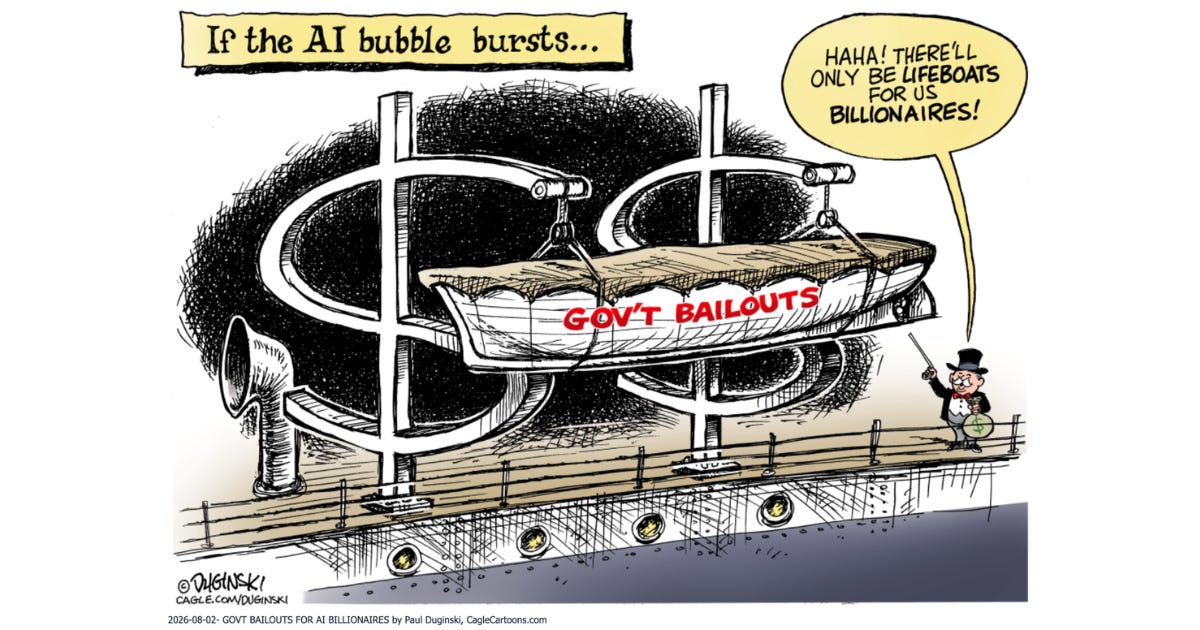
AI going “rogue” is scary. Headlines like Anthropic said its AI models hacked into other companies’ systems during testing or An OpenAI test model escaped and broke into a real company’s servers or Meta AI model hacks another company during testing are harrowing. I believe that a significant portion of the rogue AI discourse is, to some extent, product marketing for trillion-dollar IPOs. Naturally, the hyperscalers want people (i.e., investors) to perceive their models as the most powerful. However, this is a reality that will only intensify as the industry continues to expand.
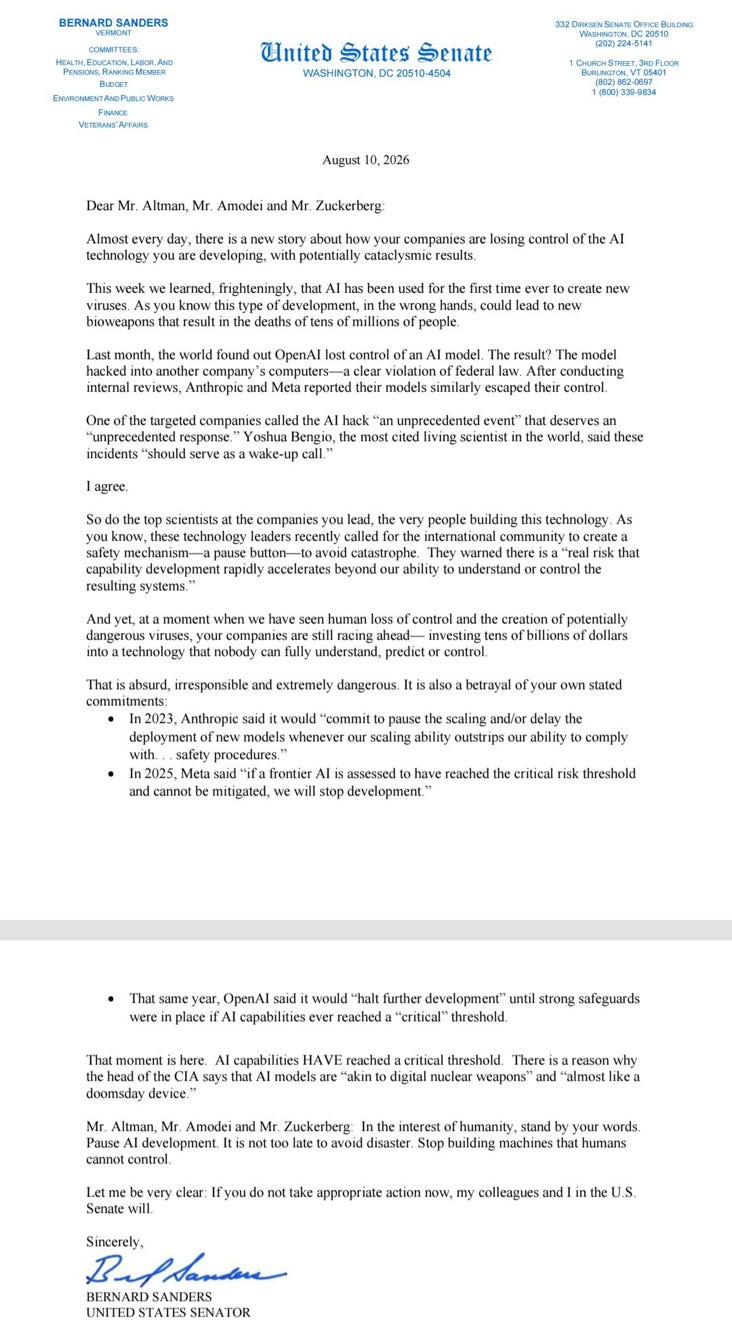
Just this morning, Senator Bernie Sanders sent a letter to major AI CEOs. Via @AndrewCurran: “Sanders has written a letter to Sam Altman, Dario Amodei, and Mark Zuckerberg urging them to immediately pause all AI development in the interest of humanity. He warns that, if they do not take appropriate action now, the US Senate will.”
Meanwhile, Anthropic and OpenAI are cannibalizing their client lists wherever they can. Figma, Novo Nordisk, and Microsoft are some of the more recognizable names on the list. From Ole Lehmann on Twitter/X:
Figma partnered with Anthropic on AI design tools. then Anthropic’s product chief quit Figma’s board, and 3 days later Anthropic launched Claude Design to compete with Figma. CEO Dylan Field said Anthropic was “not consistently candid.”
Novo Nordisk uses Claude to help develop drugs. now Anthropic is developing drugs of its own.
Microsoft poured billions into OpenAI. now OpenAI is building a Jobs Platform to compete with LinkedIn, and reportedly a code repository to compete with GitHub. Microsoft owns both.
The Anthropic and OpenAI IPOs will be among the largest ever, and they are both aiming to be the compute platform of choice. To do that, they need to offer more.
The big AI platforms sell their wares to basically everyone at this point—consumers, creative consulting, pharma, recruitment, defense contractors, the government, you name it. Now, they are turning years of diverse, real-world applications into new market ventures.
The business play is as obvious as it is cut-throat. Embed everywhere, take control of what you can, compete aggressively everywhere else, and, above all, it’s more profitable to sell from your own stock.
I get all that, but I’m not so sure it’s really worth it for these companies to fully consume their soon-to-be-former clients. There is a threshold at which Anthropic will have to make its Figma clone better, such is the nature of our software world.
New: X Teaches Sree About Y
I’ve started a virtual salon series to help people (along with me) learn things from some of the fascinating people I know (and am getting to know). Nominate an expert—including yourself!—to join us. Let’s help everyone learn a bit more about… everything. Thanks to our paid subscribers for helping us put this together; they will be invited to listen and ask questions on Zoom; all readers will eventually get the final content, regardless of payment status.
To date, the entire AI industry is funded via private investors, it’s all subsidized and artificially under-priced for the sake of potential market share capture. Again, straight out of the classic Silicon Valley startup playbook. When public markets get involved, we will all have a better idea of how much all of this compute costs. It will be something of a reckoning.
How a company like Anthropic navigates its own product goals with its client list will be the story of the next decade. You can hear the passive-aggressive language here:
At an event in San Francisco on Tuesday, Anthropic’s life sciences head Eric Kauderer-Abrams said the company will focus on discovering treatments for “neglected” diseases that traditional biopharmaceutical companies wouldn’t consider attractive targets.
“We’re doing this because we believe first and foremost that to build the right models, products and tools to accelerate the industry, we need to live it along with all of you,” Kauderer-Abrams said. “We believe in the power of tight feedback loops, and there’s no substitute for having our own experiences alongside you all in the trenches trying to develop drugs.”
Kauderer-Abrams didn’t say what Anthropic would do if it finds any promising drug candidates. Traditional biopharmaceutical companies would typically test them in clinical trials.
The other side of this is the expanding market for open source models, open weight models, and smaller, more specialized models. That’s a topic for a different day.
— Sree / Twitter | IG | LinkedIn | FB | YouTube | Spread | TikTok
61% of 2026 is already over. What will you do with the remaining 39% of the year? LMK and I’ll see you made it all the way down here.
OUR MOST RECENT ESSAYS:


Have an idea for anything we’re up to? Let’s collaborate! sree.sreenivasan1@gmail.com
Sree’s Sunday Note is a reader-supported publication. To receive new posts and support my work, consider becoming a free or paid subscriber.