


Here is “Identity Theft: Post-Stroke Recovery” in its entirety. Watch it, share it, send it to someone who needs to hear how other people are adjusting to life after stroke and preventing it in the first place. One of two events about stroke issues back to back last week (see more info about the Indiaspora one below).
🙏 Thank you to all our new paid Substack subscribers! They and our sponsors help us do more. Prefer Patreon? You can chip in $2 or as much as you like to support all our online shenanigans: this newsletter, the Sunday NYT Readalong, the 30-group WhatsApp Community I run (specialized groups on AI, hip hop, baseball) and more! Here’s our Patreon link.
📚 “The greatest literary show on earth” — Tina Brown. Are you a journalist, creator, blogger, writer, etc? If so, JLF USA (six American cities + Toronto representing the North American editions of the Jaipur Literature Festival in Sept & Oct) wants to connect with you and give you special access to the amazing speakers, authors, etc, appearing at the literature festivals. Just fill in this form or write to jlfusa@digimentors.group.
* * *
STROKE SURVIVORS ARE INCREDIBLE. I recently hosted an online discussion organized by Stroke Onward and the Forum for Medical Ethics Society and was so impressed by the survivors and the people who care for them, as well as the doctors who take care of them.
Stroke severely alters, or completely takes away, that which defines us: Our work, our passions, the ways we connect with the people we love. The hardest part of recovery is often not physical. It’s a constant struggle to answer the question: “Who am I now?”
Mukul Pandya, a dear friend, veteran journalist, founding editor of Knowledge @ Wharton, Stroke Onward board member and stroke survivor, was on the panel and shared some powerful thoughts with us for this edition of the newsletter. From Mukul:
Stroke does not just change your body; it can rob you of your sense of self. In the aftermath of mine, I fell into a serious depression, which I have written about here. What helped me find a way through was Identity Theft, by Debra Meyerson and Danny Zuckerman (the second edition is co-authored with her care partner, Steve Zuckerman).
The book gave me the language for what I was living: grieving the person I had been, and then “bouncing forward.” That meant not returning to who I used to be, but growing into a new identity. I’ve learned that people are stronger than their strokes.
It’s an unthinkable, almost alien space to even consider, let alone live with. But, many, many people are. According to the World Health Organization, stroke was the third leading cause of death and disability globally in 2021. Shockingly, the lifetime risk of stroke has increased by 50 % over the past 20 years. There is a 25% chance that I will have stroke in my lifetime.
Like so many of our societal health challenges, there is a lot we can do to lower the chances of experiencing strokes. For South Asians, the risk is especially acute. It’s much the same as the elevated diabetes risks—stroke and diabetes are closely related. I am documenting my own journey with pre-diabetes (powered by Arogya World) and all of what I heard about stroke sounded almost eerily familiar.
NEW BOOK: Lotus Leadership: A Modern Playbook of Ancient Wisdom (Harper’s Business, Sept. 22)
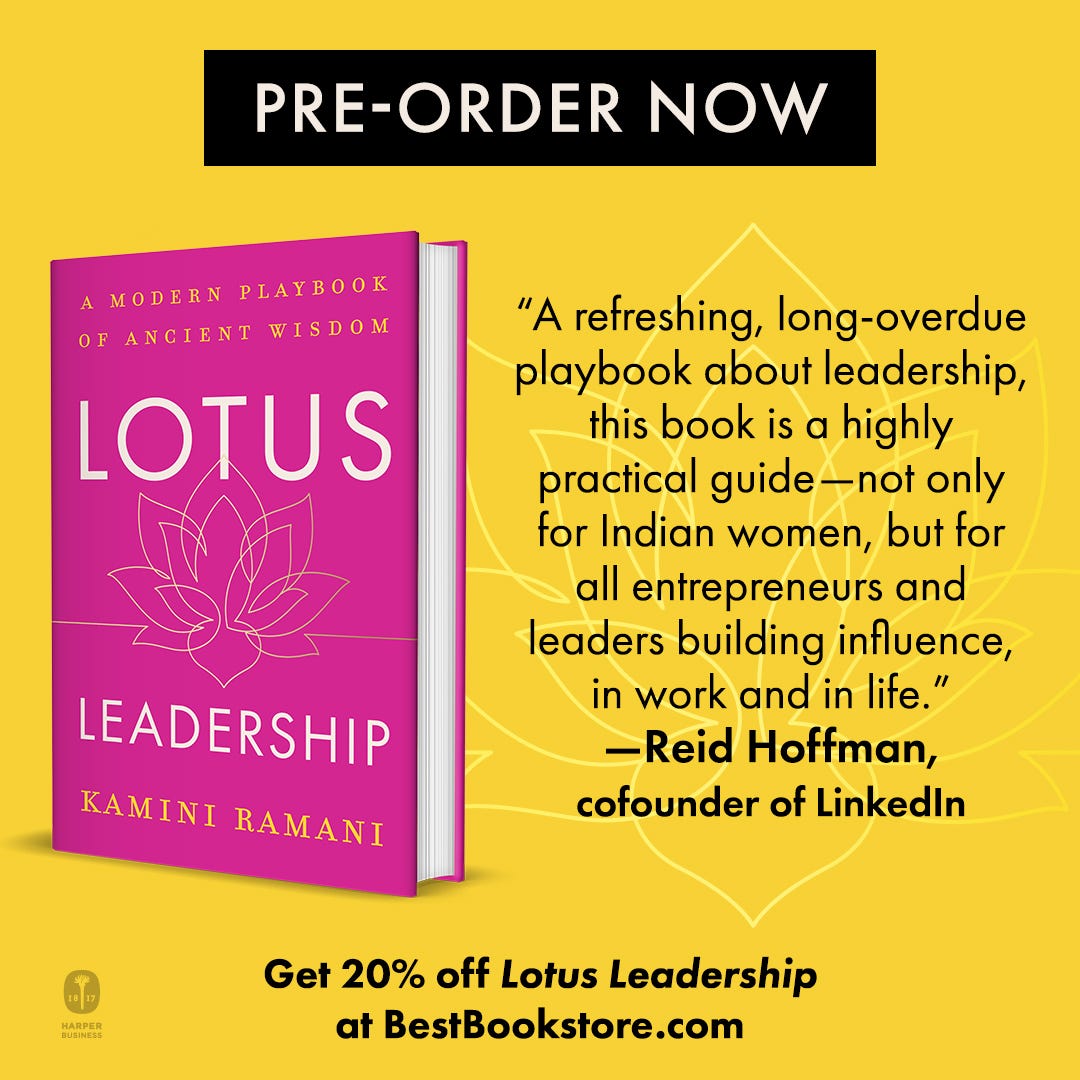
We’ve been ignoring the surging force of Indian women in American business for far too long. Not anymore. In Lotus Leadership: A Modern Playbook of Ancient Wisdom, this one-of-a-kind book, Silicon Valley leader Kamini Ramani unveils a modern playbook for success culled from the inspiring stories of 30 of the most powerful Indian leaders, along with three women of color leaders of non-Indian origin. The book, from Harper’s Business, launches Sept 22; get 20% off when you pre-order now.
Leaders include legendary PepsiCo CEO Indra Nooyi, board members of Uber and Levi Strauss, leaders from Amazon, Google, Intel, Waymo, Zoom, award-winning academics from Caltech and Yale, and movement creators of MomsFirst and RoomtoRead.
Lotus Leadership distils their paths into a framework likened to a “yoga for business” practice that can be followed by everyone, no matter where they are from.
Here are some things that increase the risk of stroke: High blood pressure, air pollution, smoking, high LDL cholesterol, high-sodium diet, high fasting blood glucose, kidney dysfunction, excess body weight, physical inactivity, and harmful use of alcohol. If you have diabetes, the risk increases even more.
I am employing technology to help me navigate my own health challenges, and I would encourage you to do the same. Healthcare is one area that keeps me from being an AI doomer—I really do think the next decade will be awash in medical breakthroughs. I am just a guy in New York, and AI has totally changed my approach to my own health, and largely for the better.
Here’s more from Mukul highlighting exactly this point:
I hear two dominant narratives about it almost everywhere. The first is the hype narrative: AI will change everything, it’s the new electricity. The second is the doomsday narrative: AI will destroy jobs and dehumanize us. Each view dominates because each contains an element of truth.
But there is a third narrative, rarely heard. If you have been disabled by stroke, AI can put you back to work and bring meaning and joy to your life. I would not have known this quieter, softer story but for the fact that I live it every day.
Speech-to-text and transcription tools have restored capabilities stroke took from me. In some ways, I feel more productive now than before. For survivors like me, AI is not a threat to purpose; it is a way back to it.
It’s incredibly moving to see restorative medicine in action.
Deborah Meyerson, PhD is also a stroke survivor. She is a Stroke Onward co-founder and, as Mukul mentioned, author of Identity Theft. Here’s a clip of her discussing her voice clone (made with Eleven Labs), and they way it has re-opened the world of communication to her. Again, very powerful.
Indiaspora, whose mision is “to inspire the Indian Diaspora to be a force for good,” as part of its South Asian Health virtual event series, recently hosted a similar discussion that focused on South Asian risk factors for stroke. Notably, the stroke episode followed conversations on cardiovascular disease and diabetes—as I said, this is all related.
Indiaspora founder and event moderator MR Rangaswami shared these thoughts with Sree’s Sunday Note:
Stroke is often preventable, yet South Asians continue to face elevated risks while remaining underrepresented in medical research. By convening leading experts and sharing evidence-based information, we hope to empower our community with the knowledge to recognize risk earlier, take preventive action, and ultimately improve health outcomes.
Here’s the full discussion, which also includes Mukul:
The message is clear: South Asians face elevated risks for stroke while remaining underrepresented in medical research. Dr. Ashish Jha, Senior Fellow, Harvard Belfer Center & CEO of BioRadar, opened the session by explaining that South Asians having a 40% higher risk of stroke mortality compared to the general population and that 80% of strokes are preventable.
A killer quote, as we say in journalism from Dr Jha, 55, who served as the White House COVID-19 response coordinator from 2022 to 2023 (was Dean of the Brown University School of Public Health from 2020 to 2025):
“The biggest predictor of whether you will have dementia in your 70s is your blood pressure in your 50s.” By American standards, 120/80 is considered fine, but as a South Asian man, he decided he needs a lower target.
Stroke is a massive risk to a significant portion of people, and South Asians need to be especially vigilant. It’s great to see accomplished medical professionals and advocates talking plainly about things like insulin resistance, abdominal obesity, diabetes, and lifestyle changes along—we need to hear this, and we need others to hear it.
Here are three excerpts from the Identity Theft event…
When stroke stole my skills — Mukul’s recovery journey:
Three truths: hope, AI tools, and resilience:
Who am I now? A survivor’s search for identity
A USEFUL WHATSAPP GROUP: Join the My Pre-Diabetic Life WhatsApp group to share tips and practical strategies about dealing with diabetes and pre-diabetes.
— Sree / Twitter | IG | LinkedIn | FB | YouTube | Spread | TikTok
OUR MOST RECENT ESSAYS:


Thank you, Sree. Really appreciate it!
Wow! This is so generous of you, Sree. Thank you so much for sharing how stroke survivors can rebuild their identities and their lives. 🙏🏽